We don’t do facial recognition.We make it useful.
Facial recognition asks: Is this face a match?
PhotoGraph asks: Is this person anywhere in this collection?
-
Entity resolution, not face matching
One person, one identity — across an entire collection, not just the photos where the face is clear.
-
A whole lifetime
Groups a person across time, cradle to grave — from a faded childhood slide to a grandparent’s snapshot.
-
Photos from the real world
Finds a person even when obscured, low-resolution, backlit in heavy shadow, or with their back to the camera.
All of it automatic, from pixels alone — no labels, no model training, and far less compute and energy than generative AI.
We find the photos other platforms miss.
Real results from one family collection: the same woman, surfaced in the shots other tools skip.
Other photo apps find

Front-facing, well lit, posed.That’s where facial recognition stops.
PhotoGraph also finds
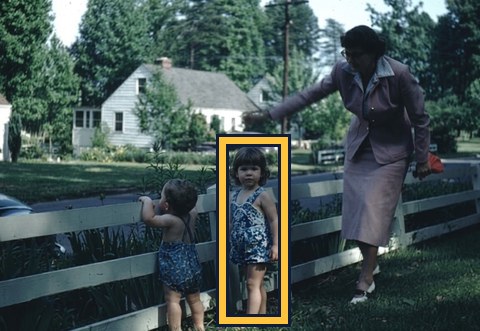
Age 3, faded slide 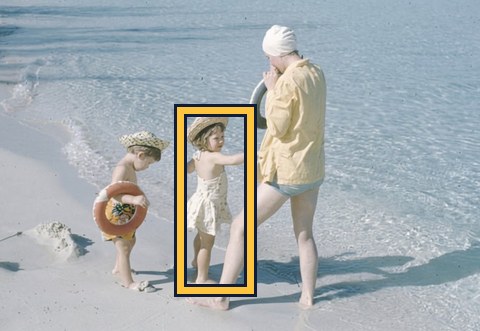
Face hidden by a hat 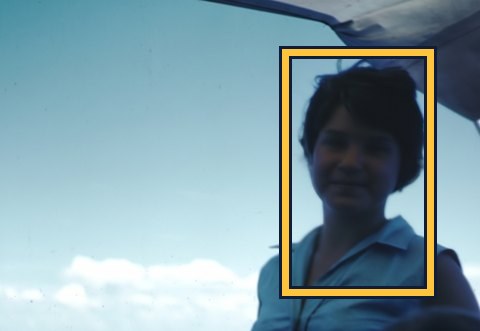
Backlit, in shadow 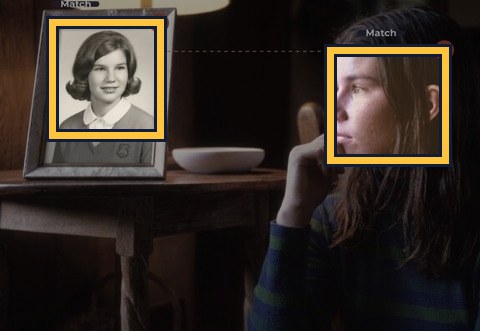
Photo of a photo 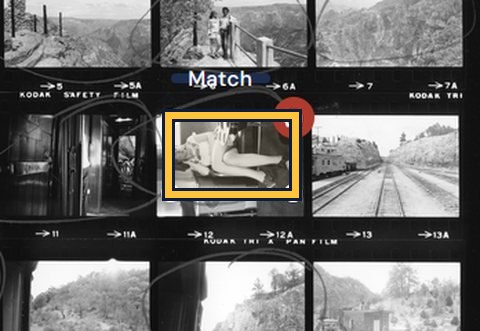
Contact-sheet frame 
Facing away 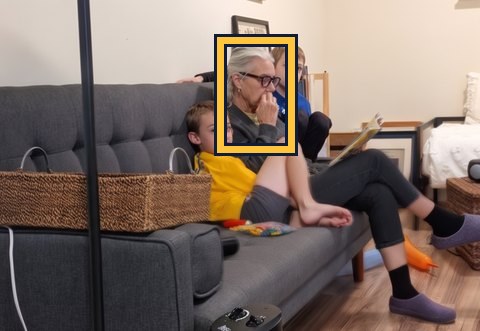
Hand over face 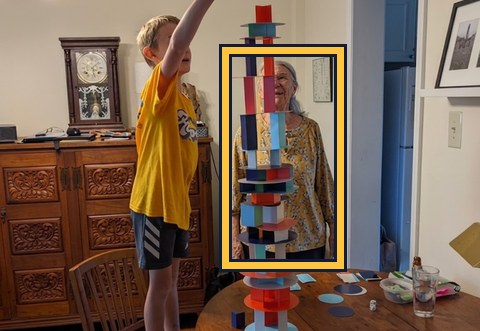
Behind a toy tower
Beyond the Face
Where facial recognition stops,
we keep going.
A face that’s partly hidden — or not visible at all — isn’t the end of the search.
For PhotoGraph, it’s just another photo of the same person.
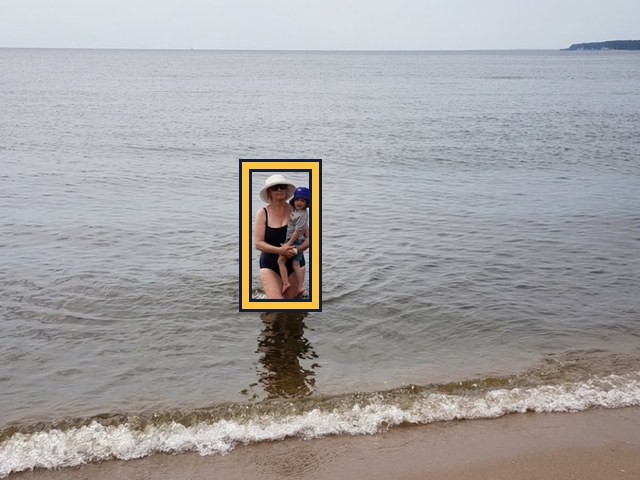

The same person, found in the shots other tools can’t use — no training, no labeling, pixels only.
The Performance Gap
PhotoGraph vs. the state of the art
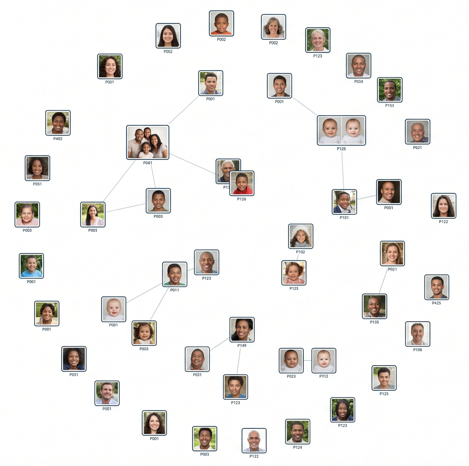
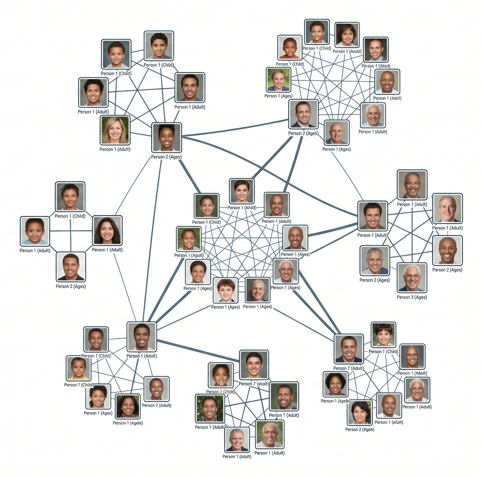
The real-world test: a true 33,000-photo family collection, and one known person who appears in 524 of them. How many “people” does each method think she is?
All 524 images — every age, film scans to digital, solo and group — held as one person.
The industry-standard method shattered the full collection into 25,395 “unique people”; its largest group held just 81 images. Nothing on the market came close — so we built our own real-world benchmark.
Live Deployment
Not a demo. Deployed.
PhotoGraph is running in production today — not in a sandbox, not on synthetic data.
PhotoGraph is live-deployed with a historical society, processing their entire institutional photographic archive. The system resolved individuals across lifetimes from separate donor collections — revealing personal histories that were previously invisible.
What we learned: Most facial recognition fails on group photos — people partially obscured, heads floating behind others — which represented a large share of the archive. We solved that problem.
What we found: Life histories surfaced on their own. A young man in his high-school portrait, then in a group shot of thirty, then a formal headshot as a manager, then at a farewell banquet — all from different donors, different scan quality, donated years apart. Brothers on the same baseball team. A fireman appearing both as a volunteer at the station and in logging crews. A woman at a recurring protest — sometimes in ordinary clothes, sometimes in deliberate costumes with obscured faces — matched across both. Each discovery added a layer to the personal histories of real people and the town they lived in. None of it was findable before.
The reaction was immediate: viewers called it unsettling how accurately it worked. Staff saw it instantly as a tool for visitors searching for family, for building narrative displays around exhibitions — and for applied uses like missing persons and fraud investigations.
Use Cases
Imagine the possibilities.
One image. One query. Every match — across decades, collections, and domains — resolved automatically inside your environment.
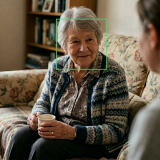
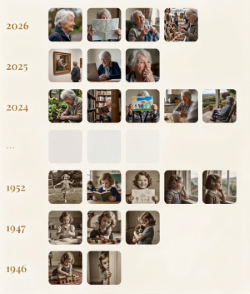
Genealogy platforms hold billions of images with no person-level navigation. PhotoGraph finds every appearance of the same individual across an entire lifetime — infant through elder — across millions of donated and archived collections, even when no names or captions were ever attached.
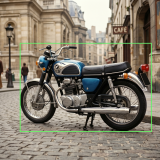
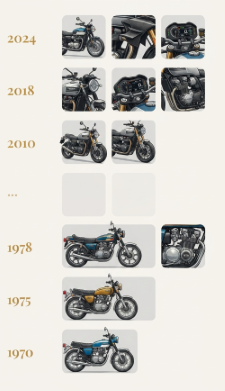
Track the visual evolution of a product line across decades — every design iteration, variant, and predecessor surfaced automatically. No reliance on metadata that was never consistently applied. Useful for IP research, design lineage documentation, and competitive intelligence.
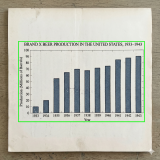
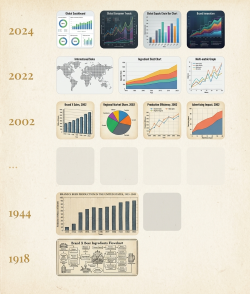
Charts, graphs, and infographics embedded in reports are invisible to text search and routinely defeat OCR. PhotoGraph resolves the visual artifact itself — finding every instance of a chart type, template, or branded figure across an entire document archive regardless of whether the underlying data was ever captured as text. Imagine finding valid correlations between seemingly dissimilar variables over time since 1800 that lead to a hitherto unknown discovery.
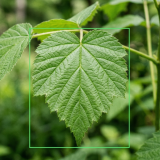
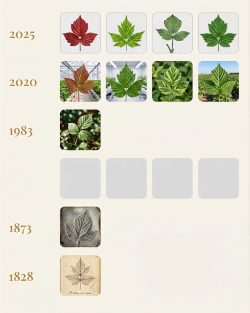
Biological collections are riddled with mislabeled specimens — decades of inconsistent taxonomy, transcription errors, and donor metadata never verified. Visual entity resolution finds morphologically similar specimens regardless of what the label says, enabling researchers to surface overlooked relationships and correct records at scale.
Imagine all of visual knowledge as a gateway to search and GenAI — versus text alone or at all.
The Problem
Vast collections.
No way to find the person.
Genealogy platforms, historical archives, and stock photo repositories, to name a few, hold millions of images — but lack the tools to connect appearances of the same individual across time, aging, and variation.
-
01
Dark, stranded inventory
Billions of photographs exist in enterprise archives with no identity linkage — invisible, unsearchable, and commercially inert.
-
02
Text dependencies
Existing solutions for entity resolution (ER) require links between ages or aliases to use text-based ER, which leave many potential image matches lost and wasting storage space with no revenue generation.
-
03
Aging and variation defeat naive matching
Standard facial recognition fails across decades of aging, generational and familial resemblance, and the quality variations of historical photography.
The Platform
Graph-native intelligence,
deployed on your infrastructure.
PhotoGraph is built on our patent-pending Graph Resolution Core (GRC) to resolve identities at scale — inside your security perimeter.
Graph Resolution Core (GRC)
Our patent-pending core holds one person together as one identity across decades — and keeps look-alike relatives apart.
Patent PendingBuilt for Scale
Resolves large collections in minutes rather than days, and scales to billions of records — on hardware you already own.
Enterprise ScaleSovereign Deployment
Full on-premises operation. No images and no results ever leave the customer's environment — by design, not policy.
On-PremisesWorks Out of the Box
No data collection, no labeling, no model training. PhotoGraph works on a customer's collection from day one, in any environment.
No Training RequiredQueryable Identity Graph
Every result is a structured identity graph that your teams, tools, and AI systems can query and build on.
Graph Query · APINatural Language Interface
Option to use LLM-powered Graph-Augmented Generation enables non-technical users to query identity graphs in plain English — ask who appears where, across an entire archive, instantly.
LLM · Graph QueryTarget Verticals
Built to keep your data
yours.
PhotoGraph was designed for data-sovereign enterprises — where companies want to maximize their IP and proprietary data, or AI solutions are disqualified by law, regulation, or institutional policy from being cloud-based or cannot allow external dependencies.
-
I
Genealogy & Historical Archives
Large genealogy platforms and newspaper archive services hold hundreds of millions of images with no person-level navigation. PhotoGraph unlocks net-new subscriber features and previously invisible inventory.
-
II
Historical Societies & Libraries
Institutions with deep photographic collections gain the ability to surface and cross-link individuals across their entire holdings — creating new research tools and donor-engagement opportunities.
-
III
Fraud and Security Companies
Companies with strict data sovereignty requirements can deploy within their own secured environments, enabling identity resolution that is categorically unavailable via any commercial cloud service.
-
IV
Enterprise Media Archives
Studios, news organizations, and media companies with legacy photo libraries gain searchable, person-indexed collections — enabling rights management, licensing, and content discovery.
Investment Thesis
Revenue generating,
not just cost saving.
PhotoGraph is not a cost-reduction tool. It enables data-sovereign enterprises to offer net-new product capabilities their customers cannot find anywhere else — creating durable, recurring license revenue from previously untapped inventory.
The market for sovereign-deployment, dark-data-to-structured-intelligence platforms is proven and growing. PhotoGraph extends that model directly into visual identity — a category with no comparable solution today.